Archive for the ‘Channel Bonding’ Tag
How Stuff Works – 802.11n and Channel Bonding
Filed under: 802.11n, Channel Bonding | Tags: 802.11n, Channel Bonding
 Comments (6)
 We already discussed how MIMO works. Let’s look at another technical improvement currently utilized in 802.11n – channel bonding:
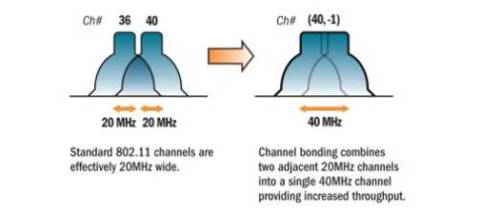
The graphic is fairly self explanatory – traditional 802.11 channels are either 20 MHz wide (OFDM) or 22 MHz wide (DSSS). Channel bonding combines two adjacent channels, which effectively doubles the amount of available bandwidth.
One footnote to channel bonding is that it works best in the 5GHz frequency band, as there is only space for three traditional, non-overlapping channels in the 2.4GHz frequency band. Therefore, there is only enough space for one bonded channel in that portion of the RF spectrum.
802.11n Challenge – Speed
Filed under: 802.11n | Tags: 802.11n, Channel Bonding, MIMO, Spatial Multiplexing
Leave a comment First, vote on the greatest deployment challenge for 802.11n in the Enterprise (if you haven’t done so already).
Let’s take a closer look at one of these challenges – speed.
There are many technical improvements in 802.11n that make it significantly faster than 802.11 a/g. In no particular order, here are some of the improvements:
- MIMO (Multiple In, Multiple Out) Antennas
- Spatial Multiplexing
- Channel Bonding
- Short Guard Interval
- Frame Aggregation
- Block Acknowledgments
It is my intent to have a blog post “tutorial” on each of these improvements, so check back shortly!

![[LinkedIn]](https://i0.wp.com/farm4.static.flickr.com/3477/3463037125_247575d1f3_m.jpg)
![[LinkedIn]](https://i0.wp.com/farm4.static.flickr.com/3598/3463037145_924738ec38_m.jpg)
![[del.icio.us]](https://i0.wp.com/images.del.icio.us/static/img/delicious.small.gif)
 WiFi Jedi.com
You must be logged in to post a comment.