How Stuff Works – 802.11n MIMO
Filed under: 802.11n, MIMO | Tags: 2x3 MIMO, 3x3 MIMO, 802.11n, MIMO, wireless
 Comments (7)
 If you have been following my blog, you know that I have a poll regarding the greatest challenges to 802.11n deployment in the enterprise. (Here’s your chance to rock the vote!)
One challenge for replacing desktop Ethernet with wireless is speed. Perhaps the widest publicized enhancement to 802.11n is that of MIMO (“my-moe”) antennas, which stands for “Multiple Input, Multiple Output”. How does MIMO work?
To answer that question, let’s look at how a classic 802.11 wireless transmitter operates:
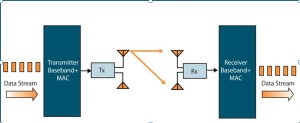
802.11 Classic Transmitter
In this case, the signal is sent out of one antenna. The signal is received by both antennas at the other end, but only one signal is processed and sent up to the MAC layer. Antenna diversity helps in the fact that the best signal is the one that is processed, but remember that it is still a single antenna that processes the receives and processes the RF energy.
Let’s compare that to a MIMO antenna structure:
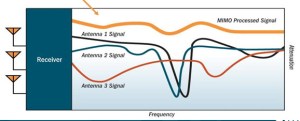
MIMO Signal Processing
In this case, we have three transmit antennas and three receive antennas (often referred to as 3×3 MIMO). The black, green, and red lines above each represent their own signal. With MIMO all three signals are received and processed up the stack. This significantly improves the receiver’s “ability to hear” and it represented in the graph above by the orange line.
You may hear different implementations of MIMO such as 2×3 and 3×3. The first number is the number of transmit antennas and the second number is the number of receive antennas. If you hear 3x3x2, the last number refers to the number of spatial streams, which I will discuss in another post.

Sugar, Spice, and Everything Nice
I ran across this article at ProBlogger.net (which is a great site BTW). The article talks about different types of content for a blog to include information for regular readers, interesting material to gain new readers, and controversial material to encourage discussion.
Being new to blogging, I would love your comments on both the form and content of this blog. What do you think about the format? Is there anything else you would like to see? What about the content? Which have been your favorite posts? What would you like to see in future posts?
802.11n Challenge – Speed
Filed under: 802.11n | Tags: 802.11n, Channel Bonding, MIMO, Spatial Multiplexing
Leave a Comment First, vote on the greatest deployment challenge for 802.11n in the Enterprise (if you haven’t done so already).
Let’s take a closer look at one of these challenges – speed.
There are many technical improvements in 802.11n that make it significantly faster than 802.11 a/g. In no particular order, here are some of the improvements:
- MIMO (Multiple In, Multiple Out) Antennas
- Spatial Multiplexing
- Channel Bonding
- Short Guard Interval
- Frame Aggregation
- Block Acknowledgments
It is my intent to have a blog post “tutorial” on each of these improvements, so check back shortly!
New Look
I hope that you enjoy the facelift that I have given my blog. I am new to Word Press and blogging, so bear with me as I learn.
My recent updates include a new theme, sidebar widgets (including links to some of my favorite websites), a few pictures, and hyperlinks in lieu of URLs.
When to Perform Pre-Implementation Planning (3rd in a Series of 3)
Filed under: Implementation/Integration, Planning | Tags: pre-implementation planning, project management, project planning, project scheduling
Leave a Comment Here is the previous portion of this particular post.
In the first two parts of this post, I spoke about the “what” and the “who” of implementation planning. Specifically I talked about pre-implementation checklists and pre-implementation conference calls. I also talked about getting buy in from senior management and taking a top down approach towards planning.
Now I tackle the question of when to preform preimplementation planning. While it is mostly common sense, my answer is “not too soon, and not too late”. I believe the sweet spot is usually 1-2 weeks before the beginning of the project. For longer projects with more detail, it may be neccessary to begin planning even sooner. For short projects (less than a week), pre-implementation planning may be done 2-3 days before the official start of the project. At that time, an official kickoff meeting may be required. We will explore the timing, audience, and agenda of kickoff meetings in a future post.
Speaking Engagement – Webinar on 1/26 at 9AM PST
Filed under: Professional Development, Speaking Engagements | Tags: Professional Development, speaking engagement, webinar, wireless security assessment
Comments (5) OK, I promised to give more notice on future speaking engagements. I am giving a Webinar on “Wireless Security Assessments” on Monday, 1/26 at 9AM PST.
Below is information about the presentation, including the link to attend along with a session description.
Webcast Live Date & Time: 9:00am JAN 26 2009 United States – Los Angeles
Duration: 45 mins
http://www.brighttalk.com/webcasts/2030/attend

Session Description – Wireless Security Assessments
Our speaker, Douglas Haider, will be presenting on the unique challenges inherent to assessing and securing wireless networks. With the recent reduction in costs of wireless equipment, it has become increasingly common for companies to implement wireless technology. Companies may desire the convenience that wireless technologies provide, but may not appreciate the security risks inherent to these systems. Adding wireless equipment to the corporate network adds a significant amount of additional risk to the I.T. infrastructure. Mr. Haider will cover some of the key tools and methodologies for identifying and mitigating these risks.
Who to Include in Pre-Implementation Planning (2nd in a Series of 3)
Filed under: Implementation/Integration, Planning | Tags: leadership, management, pre-implementation planning, project management, project planning
Leave a Comment Read the first part of this post if you haven’t already.
In the first part, I talked about pre-implementation conference calls and pre-implementation checklists as planning tools that ensure a smooth deployment of a new technology.
One area that I didn’t discuss was who to involve in these processes. Because we are talking about a change – either in the form of implementing a new technology or in the form of upgrading an existing one – it is best to have senior management involved. Any business book on change or change management is likely to tell you the same thing.
*Why* is it important to get these individuals involved? I believe two main reasons. First, a top-down approach ensures that individuals with the proper authority make (or approve) decisions. If decisions are made by those with no authority, large amounts of re-work become a credible threat to the project as original decisions may be overruled. You also can’t make much progress if there is no one involved in the planning process who is willing and able to make decisions.
Second, besides having authority, most leaders are decisive. This makes project planning more efficient because they are able to quickly settle any disputes around network architecture and design. As the old saying goes, “there’s more than one way to skin a cat”. I also think this is applicable to network architectures – there are often many different ways to design a network to meet the business and technical requirements at hand. Having senior management involved can eliminate the often spirited debates that arise on which design is best.
Speaking *Today* at PHX ISSA Meeting
Filed under: Professional Development, Speaking Engagements | Tags: 802.11, Ditch the Switch, Ethernet replacement, wireless
Comments (1) For those of you in the Phoenix area, you can hear me speak about “Replacing Desktop Ethernet with WiFi” this afternoon at the Phoenix ISSA meeting. My company, Xirrus, had some messaging around this with their “Ditch the Switch” campaign at last year’s INTEROP. Come see how 802.11n, 802.11e, and other improvements in the IEEE specs are making wireless as fast, safe, and reliable as Ethernet to the desktop.

The ISSA meeting is held at ITT Technical Institute from Noon until 5PM:
5005 S. Wendler Dr.
Tempe, AZ 85282
Directions:
(NW Corner, I-10 & Baseline, Across from Fry’s Electronics)
- Exit Interstate 10 at Baseline Road in Tempe, and turn West.
- Go 1 block, and Turn North (Right) on Wendler,(the 1st light and 1st street past the underpass).
- ITT Technical Institute is on the right beyond Denny’s.
I will post information about my upcoming speaking engagements in a more timely manner. Stay tuned!
What to Include in Pre-Implementation Planning (1st in a Series of 3)
Filed under: Implementation/Integration, Planning | Tags: 802.11, integrated access point, pre-implementation checklist, project management, project planning, wireless, Xirrus
Comments (1) I am starting a large district wide implementation of our Xirrus arrays. This particular deployment is 150+ arrays. For those of you who are unfamiliar with Xirrus, we aggregate from 4-24 radios (we call them integrated access points) in every device along with a non-blocking Layer 2 switch, WLAN controller, integrated threat sensor and spectrum analyzer. Our integrated access points utilize directional antennas, which allow us to cover more area using 75% less devices than our competitors.
This is helpful to understand the scope of the project. While we have 150+ arrays, the competing bids were for approximately 600 access points. It is certainly not the largest WLAN rollout I have worked on, but larger than most. My question today is “How do you plan/prepare for large deployments of new technology?”
My personal philosophy goes back to an adage that my father taught me, which was “Measure twice. Cut once.” There are certain processes that I have used over the years. These include both a pre-implementation call and a pre-implementation checklist.
The pre-implementation call seems more useful when I have not been involved in the sales effort and the project is being passed to me as an engineer for integration into the customer’s network. Normally, the sales team, project manager, and implementation team get on the phone to restate the technical and business requirements of the project to ensure everyone is on the same page. In my opinion, one of the frequently overlooked areas on this type of phone call is a definition of the project’s success criteria.
The pre-implementation checklist has been more useful to me in situations where I have been a part of the sales cycle and know the account history and requirements. What I am looking for then are the technical details – the IP addressing scheme, the naming convention, the authentication methods, the encryption schemes, etc.
I have used several different forms and versions of pre-implementation checklists. What format do you prefer – Excel Spreadsheets or Word documents? Ones with a higher number of detailed questions or ones with a few number of high level questions? What area(s) do you think are often missed during the planning stage of a new project?

![[LinkedIn]](https://i0.wp.com/farm4.static.flickr.com/3477/3463037125_247575d1f3_m.jpg)
![[LinkedIn]](https://i0.wp.com/farm4.static.flickr.com/3598/3463037145_924738ec38_m.jpg)
![[del.icio.us]](https://i0.wp.com/images.del.icio.us/static/img/delicious.small.gif)
 WiFi Jedi.com
You must be logged in to post a comment.